The 1031 Land Parlay: Defeat Texas Land Capital Gains
The Deal Brief
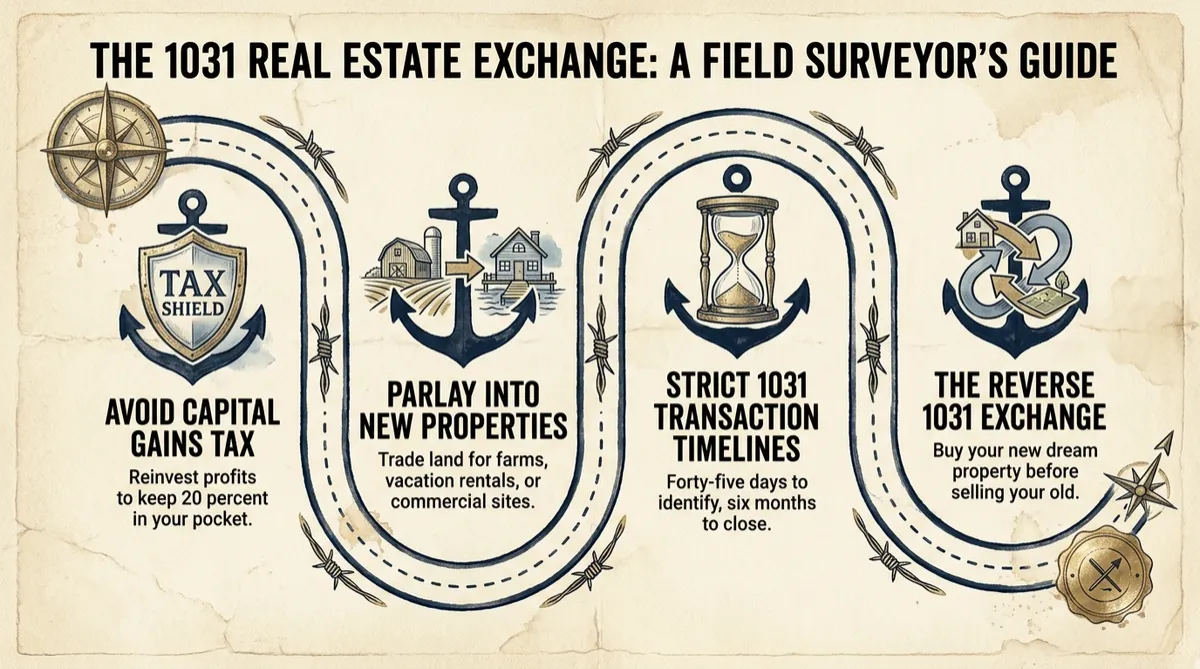
The 20% Equity Wipeout: Selling legacy farm or ranch land without a tax mitigation strategy immediately surrenders up to 20% of generational wealth to capital gains taxes—an entirely avoidable outcome.
The Strategic Parlay: A 1031 Exchange is not merely a tax loophole; it is a wealth-compounding vehicle that allows landowners to transition equity from raw land into high-yield, income-producing assets (from diverse commercial real estate to vacation rentals).
The Reverse Strike Capability: Landowners do not have to sell first and rush to buy later. Utilizing a Reverse 1031 Exchange allows buyers to secure a highly coveted target property before relinquishing their current asset, entirely removing the pressure of the IRS’s ticking clock.
The Legacy Split: Inherited land does not have to trap families in joint ownership. By structuring the sale through individual percentage disbursements, heirs can independently deploy 1031 exchanges into assets that fit their specific stage of life.
The Market Shift
For decades, the standard playbook for liquidating rural real estate has been painfully linear and financially punishing. The "Old Way" dictated that when it was time to step away from agricultural operations or dissolve an inherited family trust, the land was sold, the cash was collected, and Uncle Sam was promptly handed 20% of the property's appreciation in the form of capital gains tax. For legacy properties acquired in the 1980s—or passed down through generations with a near-zero cost basis—this traditional approach results in a catastrophic destruction of wealth. When millions of dollars of raw equity are on the line, accepting a 20% penalty is not just a cost of doing business; it is a failure of strategic planning.
Craig Cooper champions a radically different, data-driven alternative. In Craig Cooper's view, the modern landowner must stop viewing the sale of a farm or ranch as a terminal event or a simple cash-out. Instead, it must be viewed as an equity pivot.
By leveraging the power of the 1031 Exchange, landowners can construct a legal and highly lucrative bridge between their past agricultural efforts and their family's financial future. Craig Cooper notes that savvy agricultural operators and investment firms have utilized this mechanism for years to bypass the capital gains tax entirely, redirecting that 20% capital drain back into their own portfolios. According to Craig Cooper, the real estate market has evolved heavily, and the options available to landowners looking to reinvest their capital have expanded far beyond simply trading one patch of dirt for another. Today, the focus is on deploying a strategic "parlay"—doubling down on generational equity to secure assets that produce passive income, hedge against economic volatility, and dramatically elevate a family's financial trajectory.
The Land Philosophy
To execute this strategy at the highest level, a fundamental mental shift is required. The most common mistake landowners make is viewing the 1031 Exchange as nothing more than an accounting trick. Craig Cooper argues that if your sole motivation is running away from taxes, you are operating from a position of defense, which often leads to poor acquisition choices and degraded asset quality.
Instead, Craig Cooper insists that landowners must operate on offense. The philosophy is not about hiding money from the government; it is about finding the optimal vehicle to make your money work harder, smarter, and with less daily friction than it did before.
"If you're going to a 1031 exchange to avoid capital gains, it's got to make sense. It's got to provide that income, and hopefully you can parlay it. That's the whole idea." — Craig Cooper
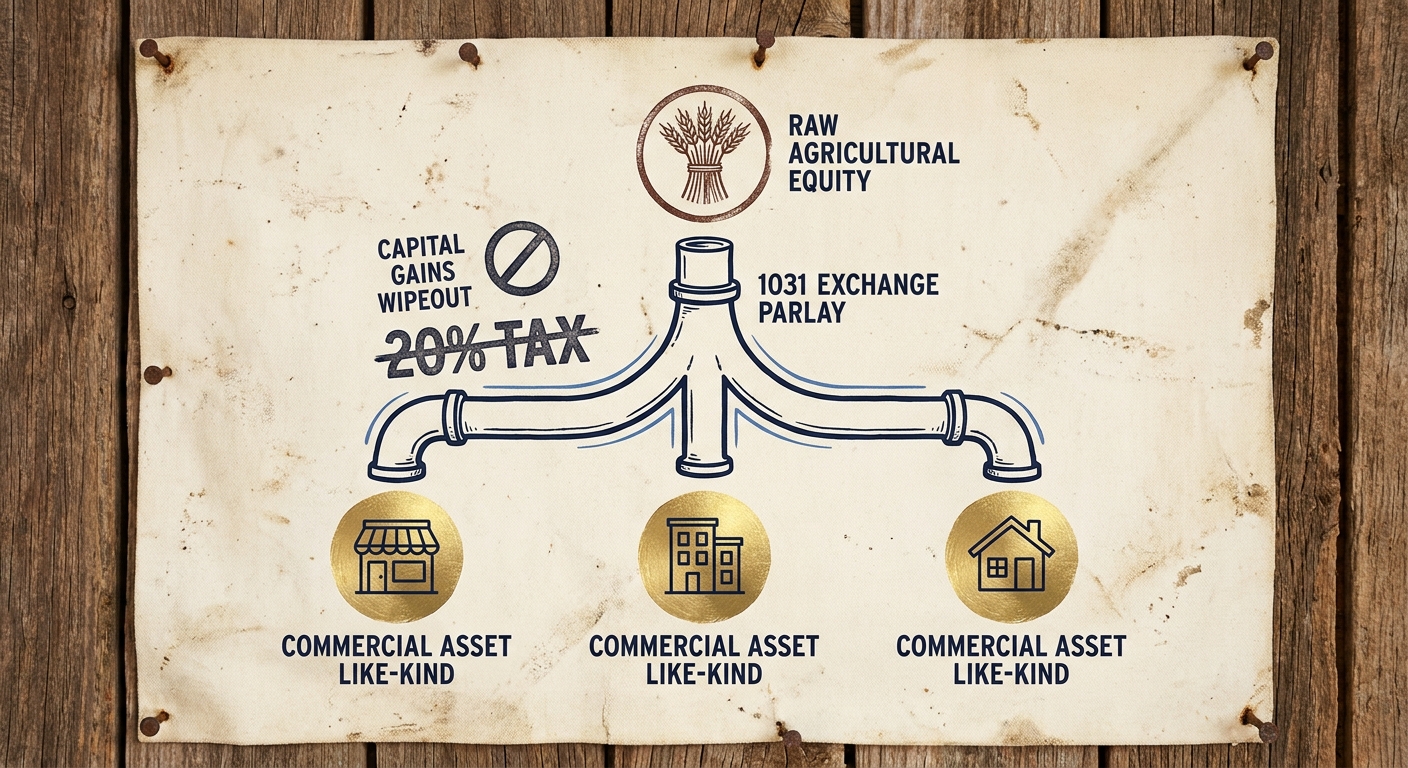
The ultimate Aha! moment for many landowners comes when they realize the sheer flexibility of the 1031 Exchange. The IRS mandates that the funds must be reinvested in "like-kind" real estate, but Craig Cooper points out that the government's definition of real estate is remarkably broad. You are not forced to exchange a panhandle cotton farm for a panhandle corn farm. According to Craig Cooper, you can transition the equity from a strenuous, labor-intensive dryland farm directly into a hands-off, triple-net-leased commercial grocery store in Chicago, a lucrative multi-family complex, or even a luxury lakehouse Airbnb in Austin. The philosophy is about matching your land equity to your current lifestyle goals.
The Deal Blueprint
Executing a flawless 1031 Exchange requires precise timing, a deep understanding of market mechanics, and a relentless focus on asset quality. Craig Cooper breaks down the fundamental steps for executing this wealth-preservation strategy.
The Profit-First Mandate
The Action: Evaluate every potential replacement property strictly on its standalone ROI, independent of its tax-shielding capabilities. A landowner must thoroughly audit the target property's income potential, geographical stability, and long-term appreciation metrics before committing funds.
The Business ROI: A tax shield is only valuable if the underlying asset is sound. By prioritizing profitability over mere tax avoidance, landowners ensure they do not save 20% on the backend just to lose 30% on a poorly chosen, depreciating asset. Craig Cooper emphasizes that exchanging into a property that drains capital or requires massive unexpected maintenance completely defeats the purpose of the parlay. The transition must result in a net-positive cash flow or a significant upgrade in lifestyle and legacy value.
"Just don't do an exchange to avoid it, and it ends up costing you… it needs to be a profitable exchange." — Craig Cooper
Mastering the Timeline and the "Reverse" Strike
The Action: Navigate the strict IRS timelines with precision, or bypass them entirely by executing a Reverse 1031 Exchange. Traditionally, once a property closes, the seller has precisely 45 days to legally identify up to three potential target properties, and a total of six months to close on one of them. If these rigid deadlines are missed, the capital gains tax is immediately triggered. To avoid this scramble, Craig Cooper advises utilizing a Reverse 1031 Exchange, where the buyer secures and closes on their ideal target property before they finalize the sale of their original land.
The Business ROI: In commercial and agricultural real estate, 45 days is a microscopic window. Forcing a massive financial decision under the duress of a ticking IRS clock frequently leads to desperate, compromised investments. By utilizing a Reverse 1031, Craig Cooper removes the anxiety and artificial pressure from the acquisition process. This allows the landowner to hunt for the perfect asset patiently, secure it on their own terms, and then sell their original property without the threat of a looming tax penalty.
"You can also do a reverse 1031. So you found the property you really wanted, and you buy it before you sell the other property, you can reverse that back into that property. So you're just not stuck." — Craig Cooper
The Asset Diversification Play (Splitting the Legacy)
The Action: For families dealing with inherited farms or ranches, structure the sale so that the legal entity is distributed into individual percentage ownerships prior to the transaction. Rather than forcing a massive family group to agree on a single massive 1031 replacement property, this allows each individual heir to take their specific percentage of the sale and execute their own independent 1031 exchange.
The Business ROI: Generational land transitions are notoriously fraught with differing opinions. One heir may want the monthly cash flow of an urban commercial building, another may want a vacation rental property, and a third may want to reinvest in local agriculture. According to Craig Cooper, empowering each individual to tailor their own 1031 exchange eliminates familial gridlock and ensures that the legacy wealth is optimized for each individual's unique financial blueprint. As long as the property functions as an investment—even a lake house rented out for just two weeks a year qualifies—the wealth is preserved.
"When they sell it, they get their ten percent. They can flip that into a 1031 exchange application, whatever they like. A lot of them do it." — Craig Cooper

Securing the Right Target Property (The Parmer County Standard)
The Action: When identifying agricultural replacement properties, demand elite fundamentals. Craig Cooper advises buyers to look for properties with proven, quantifiable water rights and immediate proximity to robust commercial infrastructure.
The Business ROI: In the Texas Panhandle, environmental volatility is the greatest risk to agricultural ROI. In a year where the region has seen a devastating three inches of rain compared to a historical average of fifteen, Craig Cooper notes that reliable irrigation is the ultimate difference between profit and bankruptcy. Furthermore, possessing prime acreage directly adjacent to a commercial dairy provides a built-in, localized buyer for commodities like corn. Acquiring a property with these ironclad fundamentals ensures that the 1031 capital is parked in a resilient, high-demand asset that will weather both economic downturns and severe droughts.
Inside the Podcast
Craig Cooper dives deeper into the strategies behind 1031 Exchanges on his podcast, The Texas Panhandle Land Report. He explores how landowners can protect their hard-earned equity, navigate the challenges of selling inherited farms and ranches, and turn the value of their land into new investment opportunities. From understanding the benefits of a Reverse 1031 Exchange to finding replacement properties that deliver lasting returns, Craig shares practical insights to help landowners make smarter decisions with their wealth.
Watch the podcast to hear Craig explain how to look beyond a traditional land sale and turn generations of hard work into a stronger financial future. If you're considering selling your farm or ranch, or figuring out what to do with inherited land, this conversation can help you see new possibilities for protecting and growing your family's legacy.
The Landowner's Advantage
Transitioning hundreds of acres of legacy property into an optimized, tax-protected portfolio requires far more than just signing a deed. It requires a market architect. The long-term competitive advantage of adopting Craig Cooper's 1031 parlay strategy is the absolute preservation of generational equity. By refusing to surrender 20% of your family's wealth to capital gains, you retain the full scale of your purchasing power, allowing you to acquire dramatically superior assets, generate higher monthly cash flows, and build a fortress around your family's financial future.
However, executing this correctly requires access to off-market deals, a massive property marketing engine, and an expert who understands the granular realities of Texas land, water rights, and commercial proximity. Craig Cooper deploys extensive capital into marketing properties globally, ensuring sellers receive peak market value while simultaneously sourcing elite replacement properties that meet strict 1031 criteria.
If you are holding a highly appreciated property, considering a sale, or navigating the complexities of an inherited land split, do not let your equity default to the IRS. Connect with Craig Cooper today at [email protected] to engineer a strategic 1031 parlay, find the perfect replacement asset, and secure your family's land legacy for the next generation.