Why Your Neighbor's Land Offer Might Cost You True Value
The Deal Brief
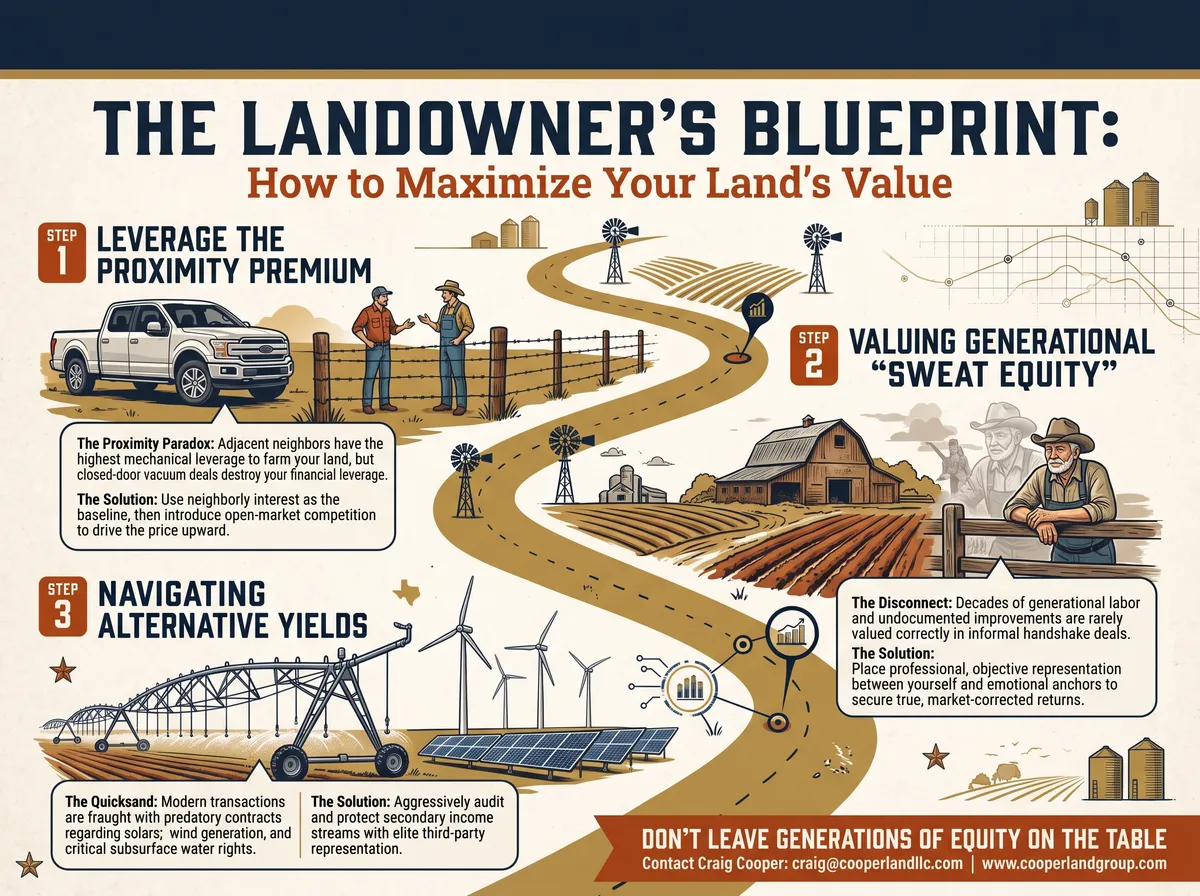
The Proximity Paradox: Adjacent landowners and local tenants naturally possess the highest mechanical leverage to farm your land, but selling to them in a closed-door vacuum destroys your financial leverage.
The Open-Market Reality Check: Forcing local interest to compete with national capital ensures maximum return on your dirt, exposing the true market value of the property.
The 'Sweat Equity' Disconnect: Decades of generational labor and undocumented property improvements are rarely valued correctly in informal, neighbor-to-neighbor handshake deals.
The Complexity of Alternative Yields: Modern land transactions are fraught with legal quicksand regarding solar leases, wind generation, and subsurface mineral demands that require elite, third-party representation to navigate safely.
The Market Shift
For generations across the Texas Panhandle, land transactions have been steeped in local tradition. The prevailing status quo often revolves around a casual conversation at the local farm store or a handshake over a cup of coffee at the local diner. The narrative is always the same: a neighboring farmer or rancher has spent years looking over the fence, waiting for the day your family decides to sell. When that day comes, the instinct is to make a quiet, off-market deal. It feels safe, it feels neighborly, and it is entirely familiar.
However, Craig Cooper argues that this traditional, insular approach to selling farm and ranch real estate is fundamentally flawed in today’s high-stakes agricultural market. The "Old Way" relies heavily on outdated local gossip and emotional anchoring. A seller might hear what a property ten miles down the road sold for last year and anchor their family's financial future to a wholly irrelevant data point. According to Craig Cooper, no two pieces of dirt are ever identical. The presence of a playa lake, the variations in soil density, the transition into lighter sandy loam, or the specific gallons-per-minute (GPM) output of a water well all dictate a unique, hyper-specific valuation that a casual neighborly offer rarely reflects.
Craig Cooper’s modern, data-driven alternative shifts the power dynamic entirely back to the landowner. Instead of accepting the path of least resistance, Craig Cooper champions an open-market exposure strategy. This approach does not alienate the neighbor; rather, it forces the neighbor to evaluate the property against the sheer weight of open-market demand. By digitizing the property’s footprint and syndicating it across premium national platforms, Craig Cooper creates a competitive environment that systematically drives the price upward, ensuring the seller is compensated for every ounce of value their land possesses.
The Land Philosophy
The fundamental mental shift required for maximizing land value is transitioning from a localized mindset to a macro-market perspective. When a family decides to sell a legacy farm, they are not just selling dirt; they are attempting to monetize generations of hardship, persistence, and intensive labor. Craig Cooper profoundly understands the emotional weight of this transition. He recognizes that landowners are often anchored by the historical burden of the property—the memory of a grandfather pouring his life into the soil—and the daunting reality of dividing an asset among multiple heirs.
This emotional attachment often clouds objective valuation. A neighbor might see a convenient expansion of their current operation, but they rarely see—or are willing to pay for—the intrinsic "sweat equity" that built the farm. Craig Cooper’s proprietary philosophy, The Open-Market Leverage Principle, strips away the subjective emotion and replaces it with objective, competitive tension.
"A bunch of old farmers and ranchers, they don't want to own everything. They just want to own what's next to them. So when does that stop?" — Craig Cooper.

This profound insight serves as the ultimate Aha! moment for landowners. The neighboring farmer's desire to expand is an asset, but only if it is leveraged correctly. By weaponizing the neighbor's inherent desire for contiguous expansion against the broader, national interest of outside capital, Craig Cooper constructs a scenario where the seller dictates the terms. The neighbor’s proximity is no longer a convenience for a quick sale; it becomes the baseline from which real negotiations begin.
The Deal Blueprint
Transforming a raw piece of agricultural land into a highly competitive real estate transaction requires a meticulous, structured approach. Craig Cooper has engineered a distinct framework for navigating these high-value deals, ensuring landowners are protected from predatory lowball offers and legal entanglements.
Step 1: Leveraging the Proximity Premium
The first critical action in Craig Cooper's blueprint is acknowledging the inherent economic advantage of the neighboring operator. An adjacent farmer can manage the land with significantly lower overhead—simply driving a tractor across the property line rather than transporting heavy equipment thirty miles down the highway. Because of this proximity, the neighbor fundamentally possesses the economic capacity to pay a premium.
However, the business ROI is only realized if the seller establishes boundaries. Craig Cooper’s approach is to list the property at a premium and present the neighbor or current tenant with the initial opportunity.
"I think you just need to broaden your horizons a little bit when you start the process… a neighbor can generally pay more than the guy that's thirty miles away. I mean, he can farm that cheaper than that guy can." — Craig Cooper.
If the neighbor balks at the true market price, Craig Cooper confidently takes the property to the broader market. The psychological impact of seeing a property officially listed often triggers a fear of loss in the neighbor, effectively bringing them back to the negotiation table at a much higher, market-corrected price point.
Step 2: Detaching from Sweat Equity and Generational Anchors
The second action involves stepping back and allowing a professional to intermediate the emotional hurdles of the sale. Farms are rarely sold seamlessly; they are often divided among multiple family members, carrying the heavy burden of legacy and, sometimes, interpersonal friction. Craig Cooper identifies that the inability to quantify historical labor is a massive roadblock for families trying to self-manage a sale.
"It's hard to value sweat… I think that's always been something that holds families back from selling it sometimes." — Craig Cooper.
The business ROI here is multifaceted. By placing Craig Cooper at the helm, the family is relieved of the intense, 24/7 burden of fielding buyer phone calls, navigating the complex paperwork of title companies, and managing intra-family disputes over the land's worth. Craig Cooper acts as the objective shield, ensuring that the legacy of the property is honored not through emotional attachment, but through securing the absolute highest financial return possible for the succeeding generations.

Step 3: Navigating the Quicksand of Alternative Land Uses
In the modern Texas Panhandle real estate market, surface dirt is only one fraction of the asset's overall value. The third critical action in Craig Cooper's blueprint involves aggressively auditing and protecting alternative yields, particularly concerning solar development, wind generation leases, and the ultimate commodity: water.
In recent years, an influx of government-subsidized solar and wind developers has flooded the market, presenting lucrative—but highly dangerous—contracts to unrepresented landowners. Craig Cooper points out that these corporate entities frequently attempt to acquire comprehensive oil and gas mineral rights as a prerequisite for solar panel installation, a demand that is both predatory and largely impossible for modern surface owners who rarely hold those deep mineral rights. Furthermore, Craig Cooper emphasizes that water remains the undisputed king of Panhandle real estate. Understanding the flow rates, playa lake integrations, and aquifer health is paramount.
"The waters get pretty deep when these other opportunities pop up… It's tough to get through all the red tape to pull something off like that." — Craig Cooper.
The business ROI of having Craig Cooper navigate this "quicksand" is absolute risk mitigation. Sellers who attempt to manage wind leases, solar contracts, or complex water rights on their own frequently sign away immense long-term value. Craig Cooper meticulously dissects these alternative opportunities, ensuring the landowner capitalizes on secondary income streams without sacrificing their core property rights or falling victim to corporate overreach.
Watch Craig Cooper Break Down the Strategy
Selling your farm or ranch to a neighbor might seem like the easiest option, but are you getting the best possible price? In his livestream, Craig Cooper dives deeper into how landowners can use open-market exposure to attract more buyers, create competition, and increase their negotiating power. He also explains how to account for the value of generational hard work and navigate complex opportunities involving water rights, wind leases, and solar development.
Watch the full episode of The Texas Panhandle Land Report to hear Craig explain why a neighbor's interest can be a starting point, not the finish line. Whether you're selling a family farm or planning your next move, you'll learn why reaching beyond your local market can help you protect your property's value and get the most out of your land.
The Landowner's Advantage
Treating the sale of a family farm or ranch as a sophisticated commercial transaction rather than a local handshake deal provides a monumental, long-term competitive advantage. Landowners who adopt Craig Cooper's macro-market strategy ensure that their family's legacy is compensated with maximum financial leverage. You are no longer reliant on the goodwill of a neighbor or the outdated gossip of the local diner; you are an empowered market participant commanding the true, data-backed value of your asset.
By integrating robust digital exposure, professional negotiation tactics, and a deep understanding of water, wind, and solar complexities, Craig Cooper consistently elevates the baseline of what Texas Panhandle land is worth. If you are preparing to transition your property and want to ensure you don't leave generations of equity on the table, it is time to bring in elite representation.
Take the first step toward maximizing your farm or ranch's true market value. Connect with Craig Cooper directly at [email protected], or explore the upcoming bold, fresh digital experience at www.cooperlandgroup.com to initiate your personal land strategy session today.