
Texas Land Market: Strategic Listings vs Auctions
The Deal Brief
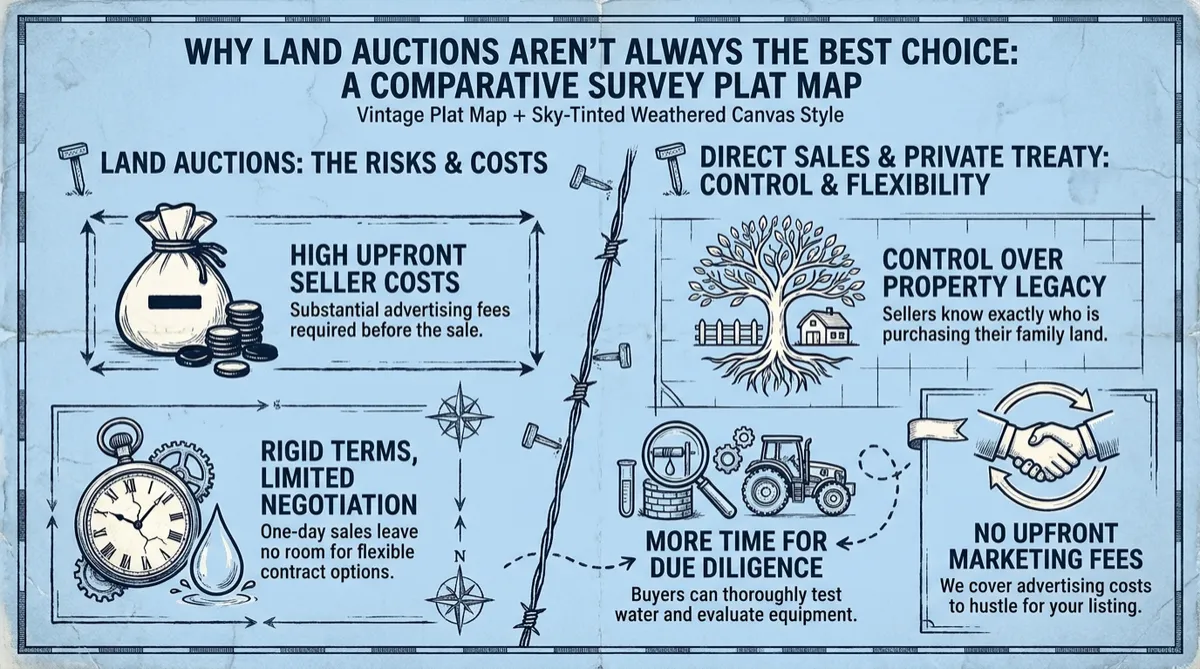
Avoid the Upfront Capital Drain: Traditional auctions often require sellers to shoulder massive, non-refundable upfront marketing costs and pass a steep 10% buyer’s premium onto the market, artificially suppressing the final net payout.
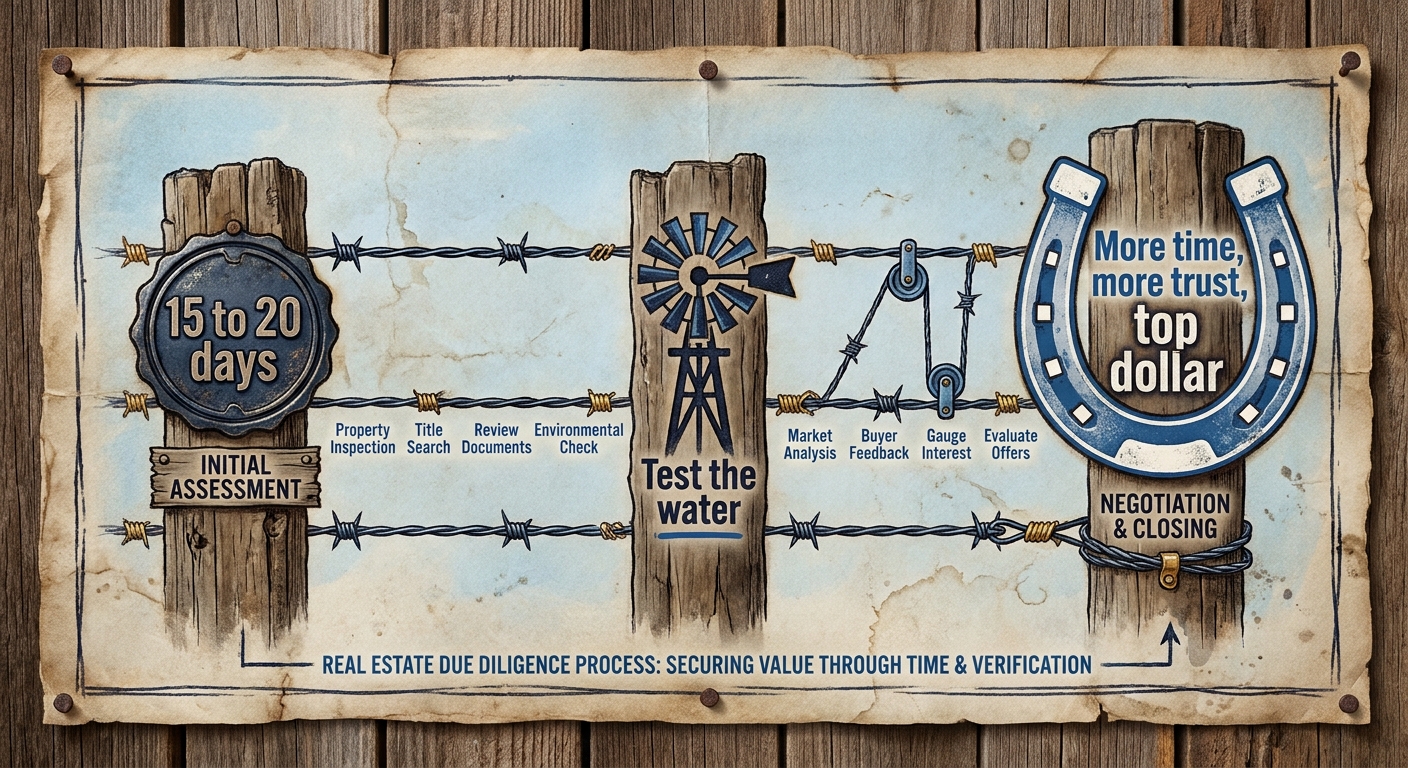
Engineer Premium Pricing Through Patience: Strategic listings provide buyers with essential 15-to-20-day due diligence windows. Allowing buyers to confidently test wells and irrigation equipment removes their perceived risk, translating directly into higher purchase offers.
Control the Legacy and the Buyer Profile: Absolute and reserve auctions leave the seller at the mercy of the highest bidder, often faceless out-of-state investment firms. Traditional listings give families the power to vet buyers and protect the fabric of their local communities.
Maintain Tactical Negotiation Leverage: Once an auction begins, the seller’s options evaporate. Listings keep the landowner in the driver's seat, allowing for the integration of advanced financial tools like 1031 exchanges and custom financing options.
The Market Shift
The Old Way: The Gamble of the Gavel
For decades, a specific segment of the agricultural real estate market has relied on the auction block as a primary mechanism for moving acreage. Particularly in states like Colorado and Kansas, where a high concentration of absentee owners dominates the landscape, the one-day auction has become a popular default. The traditional mindset assumes that creating a high-pressure, single-day event will force competitive bidding and result in a quick, painless exit for families who no longer live near their properties.
However, according to Craig, what works for an absentee owner in the Midwest does not necessarily align with the complexities and relationship-driven nature of the Texas Panhandle market. In the old model, the seller rolls the dice. They pay substantial marketing fees upfront to an auction house, set a "PO" (Pass Out, or reserve) price, and cross their fingers that the right buyers happen to be available, attentive, and liquid on one specific Tuesday afternoon. If the weather is bad, if a key buyer is tied up, or if the market simply flinches, the property goes unsold, immediately stigmatizing the land for future sales.
The Modern Alternative: The Data-Driven Strategic Listing
Craig argues that a strategic, professionally managed traditional listing is a far superior method for maximizing land value and minimizing seller risk. Rather than forcing a limited pool of buyers to make snap decisions based on restricted data, the modern approach stretches the timeline intentionally.
In this model, the broker absorbs the upfront marketing risk, handling the drone photography, the digital campaigns, and the network outreach, without charging the seller out-of-pocket before a sale is made. More importantly, it keeps the landowner actively involved in the negotiation. By holding the line rather than rolling the dice, sellers maintain total control over contract terms, timelines, and the ultimate fate of their property.
The Land Philosophy
The transition from a quick-fix auction mindset to a strategic listing methodology requires a fundamental shift in how landowners view market value. Craig’s approach is built on a deep understanding of buyer psychology: risk and price are inversely correlated. When you force a buyer to purchase a multi-million dollar ranch or irrigated farm "as-is" on auction day, you are forcing them to swallow the risk of the unknown. To compensate for that risk, they will inherently lower their bids.
"Selling Texas land isn't about rushing the market on a single afternoon; it's about engineering buyer confidence through time, transparency, and strategic negotiation. When you give a buyer the runway to truly evaluate a property, you eliminate their fear of the unknown. That confidence is exactly what drives premium valuations." — Craig Cooper
The Standalone Aha! Moment: The true cost of an auction isn't just the upfront marketing fee; it is the silent penalty of suppressed bids. By offering a standard 15-to-20-day termination option in a traditional listing, the buyer takes on the burden of testing the water, inspecting the sprinklers, and verifying the soil. By allowing them the time to prove the property's value to themselves, the seller effectively transfers the risk away from the transaction, allowing the buyer to confidently pay top dollar.
The Deal Blueprint
To truly understand why Craig advises a measured, listing-based approach over the auction block, landowners must examine the mechanics of the transaction. The following framework outlines the operational and financial advantages of holding the line.
Shift the Capital Risk Away from the Landowner
The Action: Partner with a broker who operates on a contingency model rather than an auction house that demands aggressive upfront funding. The Business ROI: In a standard land auction, the firm's primary goal is to buy an audience for their specific event. To do this, they require the landowner to foot the bill for extensive localized and national advertising before a single bid is cast. If the property fails to meet its reserve price, that money is simply gone. Furthermore, auction houses typically charge a 10% buyer's premium. This means a buyer walking in with a $2 million budget knows that $200,000 of their capital is going straight to the auctioneer, leaving only $1.8 million for the landowner.
According to Craig, traditional listings flip this dynamic. The broker puts their own capital, time, and reputation on the line to market the property. There is no upfront cost to the seller, and no hidden premium cannibalizing the buyer's purchasing power.
"It's a pretty big upfront cost for the seller advertising. And, you know, generally it's a ten percent buyer commission." — Craig Cooper
Engineer Premium Valuations Through Due Diligence
The Action: Structure the contract to include a 15-to-20-day termination option, allowing buyers full access to evaluate the property's operational assets. The Business ROI: Farm and ranch land in the Texas Panhandle is highly technical. The value of a property is intrinsically tied to its subsurface water capacity, the condition of its irrigation equipment, and its agricultural yield history. At an auction, buyers are handed a packet of pre-compiled data and told to trust the auctioneer's tests. This lack of independent verification breeds hesitation.
Craig's strategy leverages time as a value-add. By allowing buyers to bring in their own well testers and equipment inspectors, the buyer builds their own case for the property's value.
"Most deals on irrigated land, I mean, you have a twenty day, fifteen day termination option. You can go test the water, test the sprinklers, test the equipment, do more of an evaluation." — Craig Cooper
Protect the Community and Control the Legacy
The Action: Retain the right to review, accept, or reject specific buyers based on their intentions for the land. The Business ROI: For many Texas families, a ranch isn't just an asset; it is a multi-generational legacy. The neighbors sharing your fence lines are often lifelong friends. When you surrender a property to absolute auction, you forfeit all control over who assumes ownership. The highest bidder might be a faceless, out-of-state investment syndicate with zero interest in the local community, wildlife conservation, or neighborly relations.
Craig emphasizes that traditional listings allow sellers to know exactly who is sitting across the closing table. If preserving the integrity of the local community matters to the family, a listing provides the ultimate veto power over incompatible buyers.
"I think listing the property is what I've seen is the way to go. I mean, you've still got your foot in the game. You can still negotiate." — Craig Cooper
Maximize Leverage with Advanced Financial Structures
The Action: Keep the negotiation window open to allow for complex, tax-advantaged transaction structures. The Business ROI: Auctions are rigid. The terms are pre-set, the timeline is unyielding, and the execution is binary. This rigidity eliminates the ability to creatively structure a deal that benefits both parties. In high-value land transactions, sellers frequently need to execute 1031 tax-deferred exchanges, which require precise timing and coordination. Buyers may need specific owner-financing terms or phased closing schedules to liquidate other assets.
According to Craig, traditional listings thrive in this complexity. By maintaining an open dialogue, the broker can piece together advanced contract options that allow the seller to maximize their net return while minimizing their tax liabilities, options that are entirely impossible in a one-day auction scenario.

The Podcast Conversation
Choosing how to sell means thinking beyond the day an offer arrives. Marketing costs, time for buyers to evaluate the ground, and room to negotiate all shape the experience for a selling family.
In this episode, Craig compares auctions with traditional listings and discusses the control each approach gives a seller. The conversation explores buyer confidence, due diligence, and the practical trade-offs behind a sale.
The Landowner's Advantage
The long-term competitive advantage of adopting Craig’s listing strategy over the auction block is absolute control. When landowners hold the line, they protect their upfront capital, empower buyers to pay premium prices through proper due diligence, and retain total authority over the legacy of their land. While auctions may offer a fast exit for out-of-state absentee owners, Texas land demands a Texas approach, one rooted in negotiation, relationship-building, and data-driven market positioning.
"It's a gamble either way. I think there's less of a gamble listing the property." — Craig Cooper
Whether you are looking to maximize the value of an irrigated farm, navigate a complex 1031 exchange, or evaluate the highest and best use of your family’s ranch, you need an elite advocate on the ground.
Contact Craig at (806) 484-1190 or [email protected].