Texas Land Valuations: Remote Buyers & Aerial Intelligence
The Deal Brief
The Geographic ROI Spread: Local operators require high operational returns, but institutional and out-of-state buyers (hedge funds, 1031 exchanges) are actively seeking secure, tangible assets with conservative 4-5% yields, often allowing them to pay a premium for the right property.
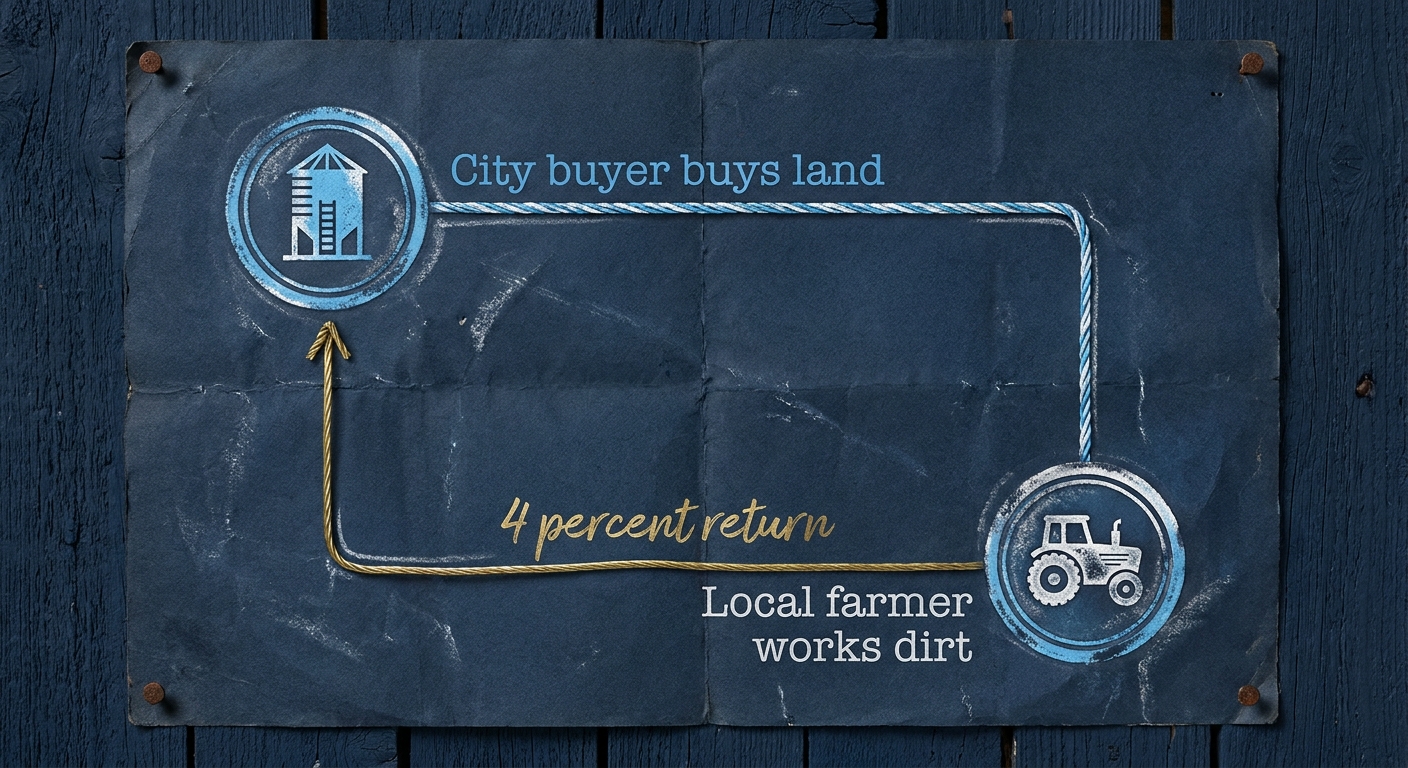
The Leaseback Catalyst: Remote investors typically do not want to operate the dirt themselves. This creates a highly lucrative scenario where out-of-town capital purchases the land and immediately leases it back to the local farmer, creating a seamless transition and sustained local production.
Subsurface Asset Valuation: To attract high-net-worth remote buyers, a property’s subsurface assets, specifically water well capacity and soil profiles (e.g., Pullman clay vs. Caliche), must be rigorously documented and presented as long-term wealth preservation tools.
Aerial Intelligence as a Trust Bridge: High-definition, context-rich drone video has entirely replaced the traditional "drive-by" inspection, allowing distant buyers to verify crop health, topographical boundaries, and neighborhood infrastructure from hundreds of miles away.
The Market Shift
For generations, the sale of Texas farm and ranch land was a highly localized endeavor. The traditional status quo relied heavily on local word-of-mouth, yard signs posted on county roads, and buyers who lived within a fifty-mile radius. In that era, evaluating a property meant driving the fence line, walking the rows, and spending hours on the ground. If a buyer could not physically travel to the Panhandle, they simply did not bid on the property. This geographic limitation artificially suppressed land values by restricting the buyer pool exclusively to local operators.
According to Craig, this archaic approach to land brokerage leaves entirely too much money on the table for the modern landowner. The market has fundamentally shifted from a local, handshake-driven ecosystem to a globalized, data-driven investment arena. Today, some of the most aggressive and well-capitalized land buyers are sitting in boardrooms in Dallas, Fort Worth, or even out of state. They are searching for hard assets to hedge against economic volatility, but they cannot physically inspect every property.
Craig argues that the modern alternative requires a sophisticated, omnichannel marketing infrastructure designed to bring the Panhandle to the buyer. By heavily investing in professional, high-definition drone videography and deploying massive capital into digital syndication networks, the geographical barriers to entry are entirely removed. Instead of relying on a dozen local farmers to drive by a listing, Craig leverages data-rich platforms to place a farm directly in front of millions of active investors every single month. This data-driven, visually immersive approach creates fierce competition, expands the buyer pool exponentially, and ultimately drives the highest possible valuation for the landowner.
The Land Philosophy
To truly maximize the exit value of a Texas farm or ranch, a landowner must undergo a fundamental mental shift regarding who the ultimate buyer of their property actually is. Most sellers naturally assume their buyer will be the neighbor across the county road or a local operator looking to expand their current footprint. However, Craig Cooper's proprietary approach is built on what he identifies as the "Institutional Yield Shift."
Local farmers evaluate a piece of land based on its immediate agricultural margin; they require a substantial operational return to justify the debt and the labor. Conversely, out-of-town buyers, institutional investors, and individuals executing 1031 tax-deferred exchanges view Panhandle land through a completely different financial lens. They are looking for capital preservation, water rights, and long-term appreciation. Because their required rate of return is structurally lower, they are often positioned to pay more for the underlying asset.
"A local farmer is looking for a bigger return generally than a corporation or a 1031 guy out of town. They're looking for a four or five percent return on that property and they're happy with it, and that might be why sometimes they can give a little more money for the property." — Craig Cooper
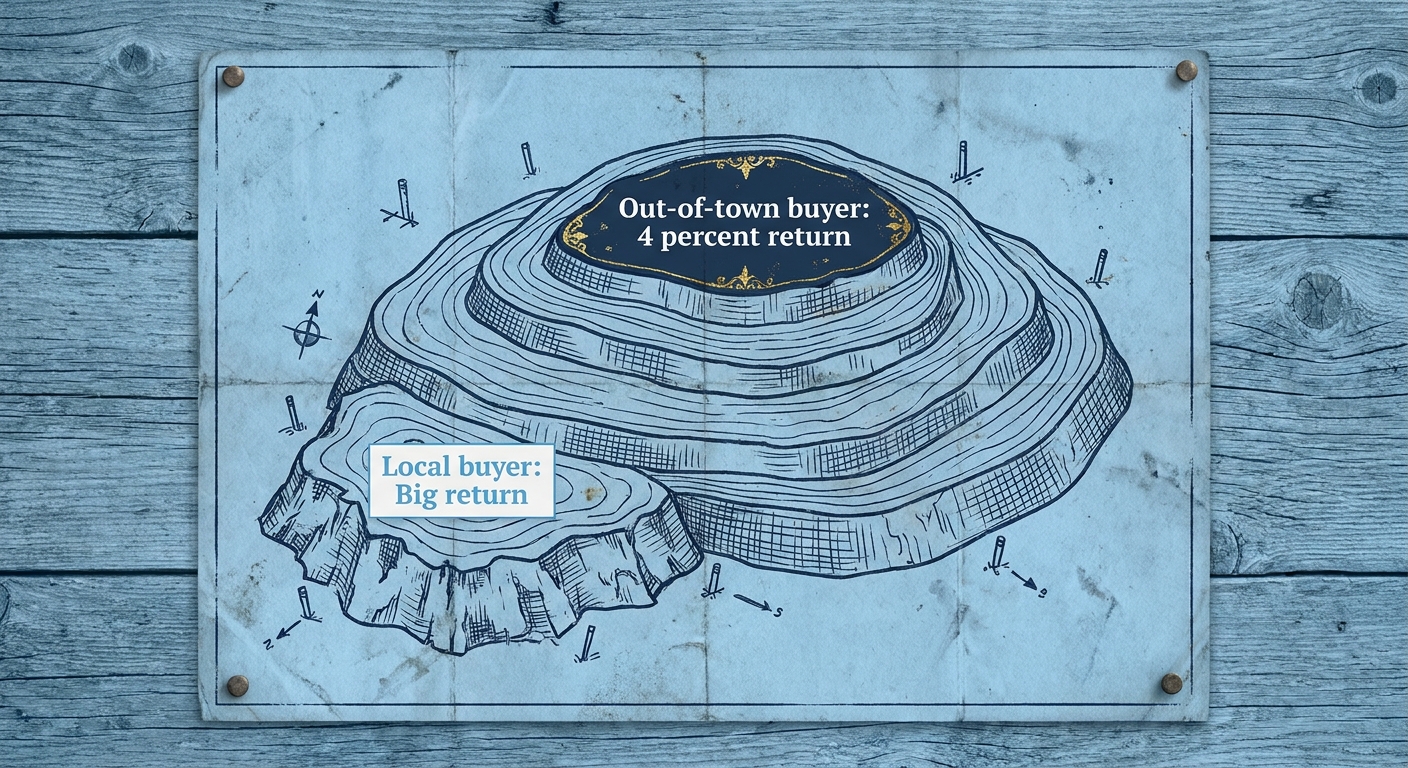
This realization is the ultimate "Aha!" moment for sellers: you do not need to extract a 10% agricultural yield to command top dollar if you can position the property for a buyer who is thrilled with a 4% institutional yield. According to Craig, unlocking this premium tier of capital requires presenting the property not just as a working farm, but as a meticulously documented, risk-averse financial instrument. The out-of-town buyer wants the security of the dirt without the operational friction. When a seller understands this, they can market the land for its subsurface security (water and soil) rather than just its historical crop yield, fundamentally changing the economics of the transaction.
The Deal Blueprint
Attracting out-of-state capital and closing deals sight-unseen requires far more than taking a few pictures with a smartphone. Craig’s methodology relies on a multi-step framework that systematically removes risk for the remote buyer while highlighting the property's highest and best use.
Phase 1: Deploying Aerial Intelligence and Boundary Context
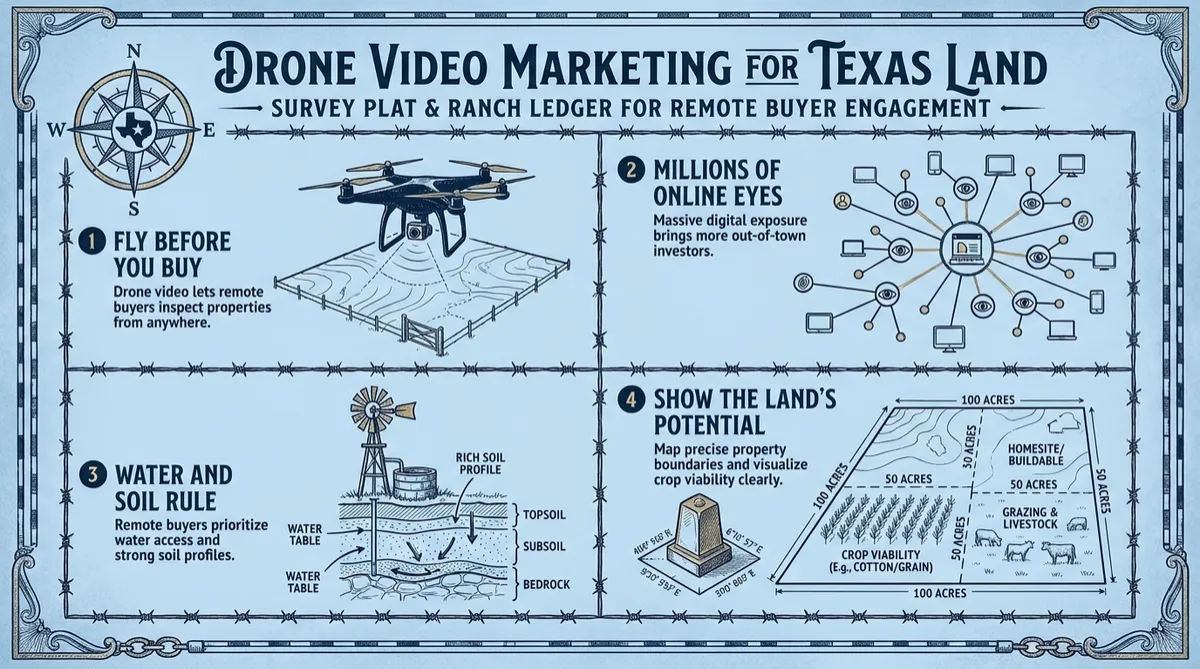
The first action in preparing a property for the modern market is securing high-level, professional drone videography. This is not merely about capturing pretty pictures; it is about providing critical spatial awareness and visual proof of production. Craig utilizes dedicated, professional drone operators to capture the land during optimal weather conditions, ensuring the crops, summer grasses, and topographical features are displayed at their absolute peak.
The business ROI of this step is immediate trust-building. Remote buyers need to see the exact boundaries of the property, the condition of the ranch house or barns, and the surrounding agricultural context (such as the proximity to active dairy farms or major roadways). By providing a sweeping, high-definition aerial perspective, Craig eliminates the guesswork that traditionally kills remote deals.
"Before we were selling land years ago, it was really hard to present a property online. They pretty much had to come look. Now today, you've got drone video, you can actually see the crops, you can see the ranch land, and it makes a big difference to somebody that's out of the area." — Craig Cooper
Phase 2: Auditing and Packaging the Subsurface Gold
While the drone captures the surface, the true value for an investment buyer lies beneath the soil. The second action is comprehensively mapping and documenting the soil profile and the water infrastructure. Craig emphasizes that out-of-town buyers are intensely focused on what type of dirt they are buying. He meticulously documents whether a farm consists of premium Pullman clay, which holds moisture and is highly manageable, or a lighter Caliche and blowing sand, which requires highly specific crop rotations (like cotton, corn, or sorghum) and strict cover crop management to prevent erosion.
Furthermore, water well capacity is heavily vetted. Craig personally inspects wells and provides detailed reporting to remote buyers. The business ROI here is the massive valuation premium attached to secured water rights. When a remote buyer has documented proof of high-quality soil and strong water production, their perceived risk plummets, and their willingness to deploy capital increases.
"Water's king to people out of town. It's a big draw. If you have decent water on your farm or ranch, it's something they really go after. It's going to be worth more than gold one of these days." — Craig Cooper
Phase 3: Architecting the Leaseback Scenario
Once the asset is visually and structurally documented, the next action is structuring the deal to appeal to hands-off investors. Craig frequently encounters buyers, such as an investor he recently worked with out of Abilene, Texas, who have significant capital to deploy into water-rich land but zero desire to operate a tractor.
The strategy is to present the land as a turnkey investment by facilitating a leaseback agreement. Craig actively bridges the gap between the incoming institutional capital and the outgoing local farmer. By setting up a scenario where the out-of-town buyer purchases the farm and immediately leases it back to the seller or a neighboring local farmer, it creates a win-win ecosystem. The business ROI is profound: the buyer gets their 4-5% passive return backed by a hard asset, the local farmer maintains their operational footprint without the burden of the mortgage, and the seller maximizes their exit price.
Phase 4: High-Impact Digital Syndication
The final step in Craig's blueprint is massive, targeted exposure. Having a great drone video and a solid soil profile is useless if nobody sees it. Craig aggressively invests between $3,500 and $4,000 every single month in premium digital advertising hubs.
By pushing listings to top-tier platforms like Land.com (which receives 11 million visits a month), LandWatch, Land and Farm, Land Hub, and LoopNet for commercial properties, he ensures the property is syndicated globally. The business ROI is a mathematical certainty: exposing a Panhandle farm to millions of eyeballs rather than a few dozen local passersby statistically guarantees a higher probability of finding that one specific buyer willing to pay a premium price.
The Podcast Conversation
Reaching a buyer who cannot visit immediately takes more than an acreage figure. Clear visuals and an organized account of the operation help that buyer understand what deserves a closer look.
In this episode, Craig discusses aerial imagery, remote buyers, and the different priorities buyers bring to a purchase. The conversation explores how presentation can make the practical features of a farm or ranch easier to understand.
The Landowner's Advantage
Adopting this modern, data-rich approach to selling land provides the property owner with an insurmountable long-term competitive advantage. By refusing to rely solely on the traditional, hyper-local buyer pool, landowners who leverage Craig's strategies immediately elevate their property from a simple agricultural commodity to a highly sought-after institutional asset. The integration of aerial drone intelligence, meticulous subsurface auditing, and massive digital syndication ensures that a property is positioned to capture the highest possible valuation from the most heavily capitalized buyers in the market.
Contact Craig at (806) 484-1190 or [email protected].